

Marble remains one of the most popular natural stone materials for kitchen countertops because of its luxurious appearance, distinctive veining, and timeless appeal. However, marble is a calcium carbonate-based stone that can react to acidic substances commonly found in kitchens. Lemon juice, vinegar, wine, and certain cleaning products can leave dull spots, cloudy patches, or visible rings on polished marble countertops.
When this type of damage occurs, professional kitchen marble restoration in NJ can help restore the stone’s appearance without requiring complete countertop replacement. With the appropriate techniques, experienced stone restoration specialists can reduce or remove etch marks, restore the desired finish, and help homeowners preserve their existing marble surfaces.
At Love Marble Stone & Restoration, we provide professional natural stone care services throughout New Jersey and the surrounding region. In this guide, we’ll explain what causes marble etching, how to distinguish it from staining, and how professional restoration can help repair marble countertops affected by acidic spills.
What Causes Marble Etching on Kitchen Countertops?
Marble etching occurs when acidic substances react with the calcium carbonate in natural marble. Unlike staining, which involves substances penetrating the stone, etching is a chemical reaction that changes the surface itself.
When acids come into contact with marble, they can dissolve a small amount of the stone’s surface, damaging the polished finish and leaving behind a dull, cloudy, or rough-looking area.
The U.S. Geological Survey’s explanation of acid reactions with marble describes how calcite, the primary mineral found in many marbles, dissolves when exposed to acidic conditions.
Common Foods and Products That Cause Marble Etching
Many everyday kitchen products contain acids that can damage marble countertops. Common examples include:
- Lemon and lime juice
- Vinegar and vinegar-based dressings
- Tomato sauce and tomato-based foods
- Wine and other acidic beverages
- Coffee and certain soft drinks
- Citrus-based cleaning products
- Acidic household cleaning solutions
- Some bathroom and multipurpose cleaners
Even brief exposure to acidic ingredients can create visible etching, especially on highly polished marble. The severity depends on the substance, its acidity, contact time, and the specific characteristics of the stone.
Because marble etching affects the surface itself, ordinary cleaning products generally cannot restore the original finish.
How to Tell the Difference Between Marble Etching and Staining
Many homeowners assume that every mark or discoloration on marble is a stain. However, marble etching and staining are two different problems that require different restoration methods.
What Does Marble Etching Look Like?
Etching usually appears as a dull, cloudy, or less reflective area on polished marble. It may also appear slightly lighter than the surrounding surface, depending on the stone’s color and finish.
Common signs of marble etching include:
- Dull rings beneath glasses or bottles
- Cloudy spots after acidic food spills
- Areas that no longer reflect light evenly
- Rough or uneven patches on polished marble
- Visible marks that do not disappear after cleaning
What Does a Marble Stain Look Like?
A marble stain develops when a substance penetrates the stone and causes discoloration. Stains may appear darker, yellowish, brown, or another color depending on the source.
Cooking oils, coffee, wine, and certain household products can cause staining, particularly when the marble is absorbent.
Some stains require specialized cleaning products or poultice treatments, while etching generally requires surface refinishing.
Professional marble cleaning services can help address certain types of staining and residue, but actual etching usually requires a different restoration process.
Why DIY Marble Etching Removal Often Falls Short
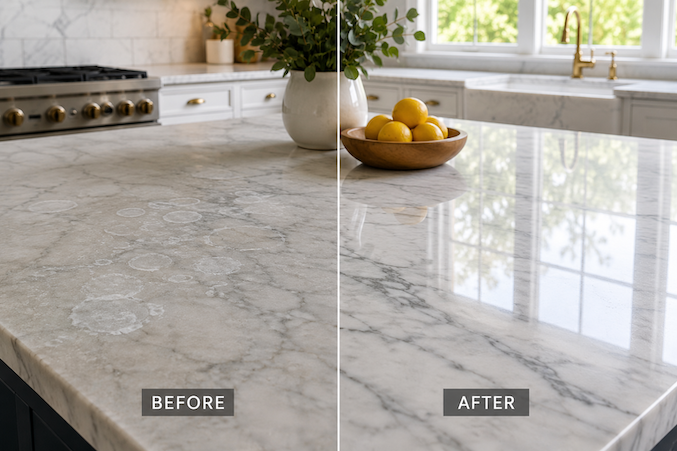
When homeowners discover dull spots or cloudy marks on their kitchen marble, they often attempt to remove them using household cleaners or DIY polishing products.
Unfortunately, these methods can sometimes make the problem worse.
Because etching is a chemical change to the marble’s surface, wiping the affected area with an ordinary cleaner will not restore the original polished finish.
Using vinegar, lemon juice, or acidic cleaning products may cause additional etching. Abrasive powders, rough sponges, and inappropriate polishing attachments can also create scratches or uneven finishes.
The National Park Service’s preservation guidance discusses the importance of using appropriate cleaning methods for sensitive masonry materials, including marble and limestone.
Can Minor Marble Etching Be Repaired at Home?
Some light etching may respond to polishing compounds specifically formulated for marble. However, results depend on the stone’s finish, the severity of the damage, and the product being used.
Improper polishing can create uneven gloss, visible rings, or additional scratches that make the affected area more noticeable.
For deeper, widespread, or highly visible etching, professional restoration is generally the more appropriate option.
Experienced restoration specialists can evaluate the stone and determine whether honing, polishing, or more extensive marble refinishing is necessary.
The Professional Kitchen Marble Restoration Process in NJ
Professional kitchen marble restoration involves several techniques designed to correct surface damage and restore the desired appearance of the stone.
The exact process depends on the severity of the etching, the existing finish, and whether the marble has additional problems such as scratches, stains, or chips.
1. Surface Inspection and Damage Assessment
Every restoration project begins with an evaluation of the marble countertop. Stone restoration specialists inspect the surface for etching, scratches, staining, cracks, and uneven areas.
This inspection helps determine the appropriate restoration techniques and whether the damage is limited to the surface.
2. Professional Marble Cleaning
Before refinishing begins, the countertop is cleaned using appropriate natural stone cleaning products.
Removing grease, dirt, and residue helps reveal the condition of the marble and prepares the surface for subsequent restoration treatments.
3. Marble Honing to Remove Etching
Honing is commonly used to address marble etching and certain types of scratches. The process involves carefully refining the stone’s surface with progressively finer abrasives.
Depending on the depth of the etching, technicians may use specialized diamond abrasives to smooth the affected area and create a more uniform finish.
The goal is to correct the damaged surface while removing only the amount of material necessary for the restoration.
4. Professional Marble Polishing
After honing, professional marble polishing helps restore the stone’s natural shine and reflective appearance.
Polishing refines the surface to achieve the desired finish and helps blend the restored area with the surrounding countertop.
Depending on the homeowner’s preference, marble may be restored to a high-gloss, satin, or honed finish.
5. Marble Sealing When Appropriate
After restoration, professional marble sealing may be recommended to help reduce liquid absorption and improve stain resistance.
However, sealing does not prevent acid etching. Lemon juice, vinegar, and other acidic substances can still damage a sealed marble surface.
The Natural Stone Institute’s guidance on sealing natural stone countertops explains how appropriate penetrating sealers can improve resistance to everyday spills and moisture.
The need for sealing depends on the stone’s absorbency, existing protection, and the manufacturer’s product recommendations.
Can Marble Countertops Be Restored Instead of Replaced?
For many New Jersey homeowners, professional marble restoration can be a practical alternative to replacing expensive kitchen countertops.
When the marble remains structurally sound and the damage primarily involves etching, scratches, stains, or surface dullness, restoration may improve its appearance without removing the existing stone.
Replacing countertops can involve purchasing new materials, removing the original slabs, fabrication, transportation, and installation.
Restoration generally focuses on correcting existing damage while preserving the original marble.
When Marble Restoration May Be the Better Option
- The countertop has dull spots caused by acidic foods.
- Surface scratches have affected the polished finish.
- The marble has visible etching or minor surface wear.
- Stains or discoloration require specialized treatment.
- The existing countertop remains structurally sound.
- The homeowner wants to preserve the original marble.
When Marble Replacement May Be Necessary
Replacement may be more appropriate when marble has severe structural cracks, substantial breakage, unstable sections, or other damage that cannot be safely repaired.
A professional assessment can help determine the most appropriate solution.
For additional information, read our related article, Marble Restoration vs. Replacement: When Is Each the Best Option?
How to Prevent Future Marble Etching From Food and Acidic Spills
Although professional restoration can correct many forms of marble etching, preventing future damage is an important part of long-term marble countertop maintenance.
Kitchen marble is frequently exposed to food preparation, cooking, beverages, and cleaning products. Developing simple preventative habits can reduce the likelihood of additional etching and staining.
Clean Spills Immediately
Acidic liquids should be removed promptly to minimize the amount of time they remain in contact with the marble.
Blot spills with a clean, absorbent cloth rather than spreading them across the surface.
Use Cutting Boards and Protective Trays
Cutting boards help prevent acidic foods and sharp utensils from coming into direct contact with marble countertops.
Serving trays can also protect the stone from sauces, beverages, and accidental spills.
Choose pH-Neutral Marble Cleaners
Use cleaning products specifically formulated for natural stone. Avoid vinegar, acidic multipurpose sprays, and abrasive cleaning powders.
Always follow the product manufacturer’s instructions and test unfamiliar cleaners in an inconspicuous area.
Use Coasters and Trivets
Place coasters beneath beverage containers and use suitable trivets beneath hot cookware.
These protective accessories help reduce direct contact between the marble and substances that could cause staining, etching, or other surface damage.
Schedule Professional Maintenance When Needed
Professional maintenance can help address developing surface problems before they become more extensive.
Restoration and resealing schedules should be based on the condition of the stone rather than a fixed calendar interval.
Kitchen Marble Restoration Services Throughout New Jersey
Marble countertops are popular in kitchens throughout New Jersey, including luxury homes, renovated residences, and custom-designed properties.
Whether your kitchen features a large marble island, traditional countertops, or a decorative natural stone backsplash, everyday cooking activities can eventually lead to visible etching and surface wear.
Love Marble Stone & Restoration serves homeowners throughout New Jersey, including Springfield, Summit, Westfield, Short Hills, Morristown, and surrounding communities.
Our team provides professional stone care services designed to help restore the appearance of existing marble surfaces and address common problems caused by everyday use.
For homeowners considering a restoration company, our related guide, Best Marble Restoration Services in New Jersey: What to Look For, explains important factors to evaluate before scheduling professional work.
Why Choose Love Marble for Kitchen Marble Restoration in NJ?
Kitchen marble countertops require specialized treatment because different types of damage respond to different restoration techniques.
At Love Marble Stone & Restoration, we evaluate the condition of each marble surface and recommend appropriate cleaning, honing, polishing, refinishing, sealing, or repair treatments.
Our services help homeowners address:
- Acid etching caused by food and beverages
- Dull and cloudy marble countertops
- Scratches and uneven surface finishes
- Stains and discoloration
- Minor chips and damaged edges
- General wear affecting natural stone surfaces
Our goal is to improve the appearance of existing marble while helping homeowners understand how to maintain their surfaces after restoration.
Restore Your Etched Marble Countertops With Love Marble
Kitchen marble countertops are an investment in the beauty and character of your home. Although acidic foods, drinks, and cleaning products can cause etching, these marks do not necessarily mean your marble needs to be replaced.
Professional kitchen marble restoration in NJ can help reduce or remove etching, restore the desired finish, and preserve the natural appearance of existing stone.
Whether your countertops have minor dull spots or more extensive surface damage, Love Marble Stone & Restoration can evaluate the condition of your marble and recommend suitable treatment options.
Contact Love Marble Stone & Restoration today to request a consultation and learn how professional marble restoration can help bring back the beauty of your kitchen countertops.