

Marble Repair in NYC: How to Find the Best Service
Marble adds elegance, character, and sophistication to homes and commercial properties throughout New York City. From polished marble floors in Manhattan apartments to kitchen countertops in Brooklyn brownstones and impressive stone features in luxury hotel lobbies, marble remains a popular choice for residential and commercial interiors.
However, even carefully maintained marble can develop scratches, cracks, chips, stains, etching, and dull finishes. Everyday foot traffic, accidental impacts, acidic spills, furniture movement, and improper cleaning methods can gradually affect the appearance of natural stone.
Professional marble repair in NYC can help address many of these problems while preserving existing stone surfaces. Whether you’re dealing with a chipped marble countertop, scratched flooring, or an etched bathroom vanity, choosing an experienced restoration company is essential.
At Love Marble Stone & Restoration, we provide professional marble cleaning, polishing, grinding, honing, refinishing, sealing, and restoration services throughout New York City and New Jersey.
In this guide, we’ll explain the most common types of marble damage, how professional repairs work, what to look for in a qualified NYC marble repair company, and how to determine whether repair or replacement is the better option.
Why Marble Surfaces Become Damaged in NYC Properties
New York City homes and commercial buildings experience different types of wear depending on their location and use.
Marble floors in busy apartment buildings may be exposed to constant pedestrian traffic, abrasive debris, and frequent cleaning. Kitchen countertops can develop etching from acidic foods and beverages, while bathroom marble may accumulate residue or experience moisture-related discoloration.
Although marble is a durable natural material, its calcium carbonate composition makes it sensitive to acids, and its surface can be scratched by abrasive particles.
According to the Natural Stone Institute’s natural stone care guidelines, acidic substances can etch calcium-based stones, while sand, dirt, and grit can damage natural stone floors.
Common Marble Problems in NYC
- Scratches caused by abrasive dirt and furniture movement
- Etching from vinegar, wine, lemon juice, or acidic cleaners
- Chips and damaged countertop edges
- Cracks in marble slabs and tiles
- Dull or cloudy polished finishes
- Stains caused by oils and other absorbed substances
- Uneven flooring and worn traffic patterns
- Discolored grout or deteriorated joints
- Moisture-related discoloration
Some problems can be addressed through professional cleaning or refinishing, while others require localized repairs or additional investigation.
Understanding the difference helps property owners avoid unnecessary treatments and choose suitable restoration methods.
What Professional Marble Repair in NYC Includes
Professional marble repair involves evaluating existing damage and selecting techniques appropriate for the stone.
Not every marble surface requires grinding, honing, polishing, repairs, and sealing. The work should be based on the condition of the marble and the results the property owner wants to achieve.
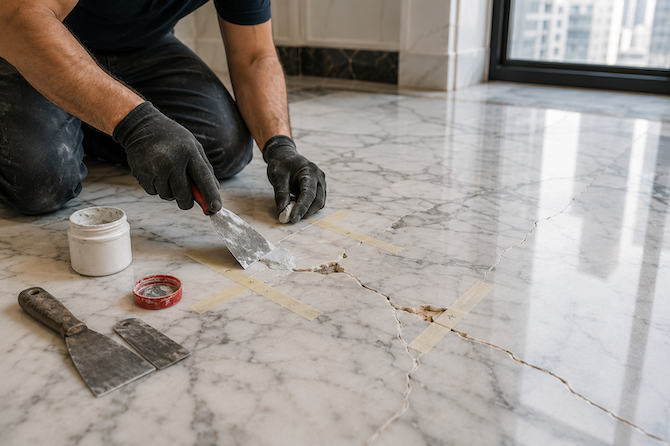
Marble Crack and Chip Repair
Marble countertops, staircases, vanities, and flooring can develop chips or cracks from accidental impacts, movement, inadequate support, or other conditions.
Some minor defects can be repaired using specialized stone repair compounds. Color matching and finishing techniques may help repairs blend with surrounding marble, although results vary with the stone’s natural veining and the extent of damage.
Cracks caused by structural movement or inadequate support require further evaluation. Cosmetic repair alone may not resolve the underlying problem.
Marble Grinding
Professional marble grinding may be recommended for certain deeper scratches, surface irregularities, or uneven finishes.
Grinding uses specialized abrasives to remove a controlled amount of stone and refine suitable surface imperfections.
For some marble floors, this process can help reduce lippage between firmly installed tiles. However, loose tiles or unstable substrates must be addressed separately.
Marble Honing
Honing refines marble using progressively finer abrasives to reduce scratches, etching, and other surface imperfections.
It can produce a smooth matte or satin appearance or prepare the stone for additional polishing.
Professional marble refinishing often involves honing when everyday cleaning is insufficient to restore the desired surface appearance.
Marble Polishing
Marble polishing helps restore the desired reflective finish of worn natural stone.
Over time, polished marble can become dull from scratches, etching, and daily traffic.
Professional marble polishing can improve the consistency and appearance of the surface when the existing stone is suitable for treatment.
For marble with deeper scratches, honing or grinding may be necessary before polishing.
Marble Cleaning and Stain Treatment
Professional marble cleaning can help remove dirt, accumulated residue, and certain types of stains.
Staining should not be confused with acid etching. A stain involves discoloration or absorbed substances, while etching results from a chemical reaction that affects marble’s surface.
Some stains respond to specialized treatments, but not every stain can be removed completely.
Marble Sealing
Some marble surfaces benefit from a compatible penetrating sealer that reduces liquid absorption and improves resistance to certain stains.
Professional marble sealing may be appropriate depending on the stone’s absorbency, finish, existing treatment, and intended use.
However, sealing does not prevent acidic etching, scratches, or all staining. It also does not resolve cracks, underlying moisture problems, or damaged installation components.
The Natural Stone Institute’s sealing guidance explains how suitable sealing treatments can improve stain resistance without making natural stone completely stain-proof.
How to Choose the Best Marble Repair Company in NYC
Choosing a marble repair company requires more than finding a contractor who offers basic cleaning or floor maintenance.
Natural stone restoration is specialized work. An experienced provider should understand the characteristics of marble and how to treat different kinds of damage.
1. Look for Experience With Marble and Natural Stone
Ask whether the company has experience working with the specific marble surface you need repaired.
A contractor who specializes in commercial marble flooring may have different experience from a technician who regularly repairs countertop chips and bathroom vanities.
Look for examples involving comparable materials, finishes, and types of damage.
2. Review Before-and-After Photos
Photographs of completed marble restoration projects can help demonstrate a company’s workmanship.
Pay attention to the quality of the finish, consistency of restored areas, and examples of repair work similar to your needs.
Remember that photographs cannot guarantee identical results for every marble surface.
3. Ask About Equipment and Restoration Techniques
Professional marble restoration may involve diamond abrasive systems, polishing equipment, stone-compatible repair materials, and appropriate cleaning products.
Ask which techniques are recommended and why.
A reputable contractor should explain whether your marble requires cleaning, localized repairs, honing, grinding, or polishing rather than recommending the most extensive treatment automatically.
4. Choose a Company Familiar With NYC Properties
Restoration work in New York City may involve building-specific considerations such as service elevators, restricted access, loading areas, and approved contractor schedules.
Condominium boards, property managers, and commercial facilities may also have rules governing contractor access and work hours.
Ask whether the company can coordinate with building management and accommodate the requirements of your property.
5. Verify Insurance and Applicable Licensing
Before hiring a contractor, request proof of appropriate insurance and determine whether the proposed work requires a specific license.
The NYC Department of Consumer and Worker Protection provides information about Home Improvement Contractor licensing requirements for covered residential repair, remodeling, and improvement projects.
Licensing requirements depend on the nature and scope of the work, so confirm the applicable rules rather than assuming all marble maintenance and repair services have identical requirements.
6. Read Customer Reviews and Request References
Customer feedback can provide useful insight into a company’s reliability, communication, professionalism, and workmanship.
Look for detailed reviews describing completed projects, including the type of stone and restoration performed.
For large commercial jobs or valuable marble installations, consider asking for references from comparable properties.
7. Request a Detailed Written Estimate
A written estimate should explain the proposed work, expected results, scheduling considerations, and any limitations.
Ask whether the proposal includes cleaning, repairs, honing, polishing, sealing, and surrounding-area protection.
When comparing contractors, make sure the quotes cover similar services.
Questions to Ask Before Hiring NYC Marble Repair Specialists
Before choosing a marble repair company, ask questions that help clarify the work and establish realistic expectations.
- Have you repaired this type of marble before?
- Can you show photographs of comparable projects?
- What caused the damage, and does the underlying issue need attention?
- Can the marble be repaired without replacement?
- Will the repaired area remain visible?
- Which restoration methods will you use?
- How will surrounding surfaces and furnishings be protected?
- How long will the repair take?
- Will the surface require drying or curing time?
- What maintenance will be necessary afterward?
- Can you provide proof of insurance and a written estimate?
Clear answers can help you distinguish experienced restoration specialists from companies that cannot adequately explain the repair process.
Residential Marble Repair Services in NYC
New York City residences contain many types of marble surfaces, from kitchen countertops and bathroom vanities to entryways and decorative flooring.
Marble Countertop Repair
Marble countertops may develop chips, scratches, stains, and acidic etching through everyday use.
Professional repair may help address localized defects, while honing or polishing can improve certain types of surface damage.
For homeowners dealing with acid etching in kitchens, our guide to kitchen marble restoration and acidic spills explains additional treatment considerations.
Marble Floor Repair
Marble floors in apartments, condominiums, and townhouses may develop scratches from furniture movement, abrasive debris, and daily traffic.
Professional restoration can improve worn finishes and address certain damaged areas without replacing the entire floor.
Bathroom Marble Repair
Bathroom vanities, shower walls, and other marble features may experience etching, soap residue, staining, and minor damage.
Stone restoration specialists can evaluate the surface and recommend cleaning, refinishing, or repairs.
Persistent moisture-related problems should be investigated before cosmetic restoration.
Commercial Marble Repair for NYC Buildings
Hotels, office buildings, luxury apartment towers, restaurants, and retail properties frequently feature marble surfaces in high-visibility areas.
Commercial marble floors can develop dull traffic patterns, scratches, stains, and other wear due to constant pedestrian activity.
Restoration work may involve large surface areas and scheduling around building operations.
Common Commercial Marble Repair Projects
- Hotel lobby marble floor restoration
- Office entrance and reception floor repairs
- Luxury condominium common-area maintenance
- Repairing damaged marble reception counters
- Restoring worn corridors and hallways
- Addressing scratches and uneven marble finishes
- Refinishing decorative stone in commercial interiors
Commercial property managers should discuss access restrictions, work schedules, and maintenance requirements before authorizing restoration.
For additional information, read our related article, Marble Restoration for Hotels, Lobbies & Luxury Buildings in NYC.
Marble Repair vs. Replacement: Which Is Better?
One of the main advantages of professional marble repair is the possibility of preserving existing stone.
Replacing marble may involve removing the damaged material, sourcing a suitable replacement, fabrication, and installation.
When the original marble remains structurally sound, restoration may be more practical.
| Consideration | Marble Repair | Marble Replacement |
|---|---|---|
| Suitable Damage | Scratches, etching, certain chips and repairable cracks | Extensive breakage or irreparable damage |
| Existing Stone | Preserves original material where suitable | Replaces affected material |
| Project Scope | May involve localized repairs and refinishing | May require removal, fabrication, and installation |
| Appearance | Improves existing finish, with results varying by damage | New stone may differ in veining or color |
| Cost | May be less expensive for suitable repairs | Depends on materials and installation requirements |
Replacement may be necessary when marble is unstable, severely fractured, or affected by underlying construction problems that cannot be corrected through restoration.
For a detailed comparison, read Marble Restoration vs. Replacement: When Is Each the Best Option?
How Much Does Marble Repair in NYC Cost?
The cost of marble repair in New York City varies depending on the type of damage, stone condition, size of the affected area, accessibility, and restoration techniques required.
A small countertop chip repair and a large marble floor restoration project have different labor and equipment requirements.
Factors That Affect NYC Marble Repair Pricing
- Severity and location of damage
- Size of the affected marble surface
- Type and characteristics of the stone
- Need for matching repair materials
- Honing, grinding, or polishing requirements
- Staining or specialized cleaning needs
- Furniture movement and site preparation
- Building access and elevator restrictions
- Off-hours commercial scheduling
Rather than relying on generic online price estimates, request a professional quote based on your actual marble.
For larger projects, ask whether the contractor can evaluate a small test area to help demonstrate the expected finish before full restoration begins.
Benefits of Professional Marble Repair in NYC
Professional marble restoration can offer several advantages for homeowners and commercial property managers.
Preserve Existing Stone
When marble remains structurally sound, repairs can help preserve original flooring, countertops, and decorative features.
Improve the Appearance of Damaged Marble
Appropriate restoration techniques can reduce certain scratches, etching, stains, and visible surface wear.
Reduce Unnecessary Replacement Work
For suitable damage, repair may help avoid removing and replacing existing marble.
Maintain Attractive Interiors
Well-maintained marble can support the appearance of luxury residences, hotel lobbies, offices, and other properties.
Support Long-Term Maintenance
Professional restoration specialists can recommend cleaning practices and preventative measures appropriate for the stone.
However, repair results vary, and no treatment can guarantee that marble will remain permanently free from scratches, stains, or future damage.
How to Maintain Marble After Professional Repair
Proper cleaning and preventative care can help preserve repaired marble and minimize avoidable wear.
Whether your marble has been polished, honed, or repaired, everyday maintenance remains important.
Recommended Marble Maintenance Practices
- Use pH-neutral cleaners formulated for marble or natural stone.
- Avoid vinegar, lemon juice, and acidic household cleaning products.
- Clean spills promptly.
- Use coasters beneath drinks and cutting boards during food preparation.
- Place entrance mats where outdoor grit may be tracked indoors.
- Dust mop marble flooring regularly.
- Use protective pads beneath furniture.
- Avoid dragging heavy objects across marble floors.
- Have new cracks or persistent moisture problems evaluated.
- Assess sealing needs based on the condition of the stone.
The Natural Stone Institute recommends regular dust mopping, suitable cleaning products, coasters, and entrance mats to help preserve marble’s appearance.
Frequently Asked Questions About Marble Repair in NYC
Can Cracked Marble Be Repaired?
Some marble cracks can be repaired using specialized stone repair materials and techniques.
The appropriate solution depends on the crack’s location, severity, and cause. Structural damage may require additional repairs or replacement.
Can You Repair Chips in Marble Countertops?
Many minor marble countertop chips can be filled and finished using suitable repair materials.
The repair may become less noticeable, although results depend on the stone’s natural color, veining, and type of damage.
Can Scratches Be Removed From Marble Floors?
Many marble scratches can be reduced or removed through professional honing and polishing.
Deeper scratches or uneven surfaces may require additional restoration.
Can Acid Etching Be Repaired?
Yes, many etched marble surfaces can be improved through professional refinishing.
Cleaning and sealing alone generally do not correct etching because it changes the stone’s surface.
How Long Does Marble Repair Take?
Project duration depends on the type of repair, surface area, condition of the marble, access requirements, and any necessary curing time.
A professional inspection provides the best basis for estimating the schedule.
Is Marble Repair Cheaper Than Replacement?
Repair may be more economical when damage is cosmetic and the original marble remains structurally sound.
However, extensive damage or unstable stone can make replacement necessary.
Should Marble Be Sealed After Repair?
Sealing may be beneficial for some marble surfaces but is not automatically required after every repair.
It can improve stain resistance when appropriate, but it does not prevent scratches or acidic etching.
Choose Love Marble Stone & Restoration for Marble Repair in NYC
Marble can remain an elegant feature of New York City homes and commercial properties for many years, but everyday use and accidental damage can affect its appearance.
Choosing an experienced marble repair company is important when addressing scratches, chips, cracks, etching, staining, or worn finishes.
At Love Marble Stone & Restoration, we provide professional marble cleaning, polishing, honing, grinding, refinishing, sealing, and restoration services throughout New York City and New Jersey.
Our team evaluates the condition of existing marble and recommends suitable treatment options based on the material, damage, and desired finish.
Whether you need to restore scratched flooring in a Manhattan apartment, address an etched countertop in a Brooklyn home, or improve worn marble surfaces in an NYC commercial building, professional evaluation can help determine the appropriate approach.
Contact Love Marble Stone & Restoration today to request a consultation and learn more about professional marble repair services in NYC.